
Abstract
This article highlights structural disparities in India’s healthcare system. Although India has made notable and sustainable progress in recent decades, important issues still need thorough assessment and monitoring to identify ways to enhance implementation. Data show that both rural and urban populations face higher costs for doctor or surgeon fees, medicines, diagnostic tests and other expenses at private hospitals and those operated by charitable trusts or NGOs. The article also reviews several government programs, noting that their recommendations require careful implementation to strengthen India’s healthcare system, especially in remote regions. Lastly, building sustainable healthcare infrastructure and reducing disparities in medical expenses are vital to ensuring affordable and effective healthcare services.
Keywords: Accountability, Affordability, Disparities, Healthcare, Infrastructure and Policy
Introduction
India’s healthcare infrastructure reflects a persistent tension between efforts to expand capacity and ongoing unmet needs. Availability, affordability, and accountability are key pillars of India’s healthcare system today. On availability, the country has significantly increased the number of medical colleges, hospital beds, primary health centres (PHCs), community health centres (CHCs), testing labs, and healthcare professionals over the past decade. Private entities provide most urban healthcare capacity, while rural areas still depend on under-resourced primary health centres (PHCs) and community health centres (CHCs). Affordability has improved following the introduction of Ayushman Bharat and related insurance schemes, resulting in measurable reductions in out-of-pocket expenditures. However, public health spending in India as a percentage of Gross Domestic Product (GDP) still needs improvement. Consequently, vulnerable populations are often excluded from effective coverage for high-cost and tertiary care services. Therefore, India’s health governance structure constrains accountability, leading to inconsistent regulatory enforcement across states and deficiencies in staffing discipline, grievance redress mechanisms, and oversight of the expanding private sector.
This piece summarises its main objectives below.
- To examine the distribution of healthcare infrastructure in India.
- To examine the structural elements that support these disparities.
- To assess the care burden experienced by patients and to analyse current policy measures to strengthen the healthcare system.
Availability, affordability, and accountability are interconnected. When public investment is limited, it decreases availability, leading to greater reliance on costly private care. This cycle weakens affordability and makes accountability more difficult. To improve universal health coverage, policies should simultaneously enhance infrastructure, financing, and governance instead of tackling each separately. According to the PIB (2025) report, as per the National Medical Commission (NMC), there are 13,88,185 registered allopathic doctors and 7,51,768 registered AYUSH practitioners. Assuming that 80 per cent of registered practitioners in both the allopathic and AYUSH systems are available. The doctor-population ratio in the country is estimated at 1:811, which is better than the World Health Organisation (WHO) standard of 1:1000 (PIB, 2026). This report also provides information crucial to strengthening the public healthcare system, including filling vacancies in Government Hospitals, which lies with the respective State/UT Governments.
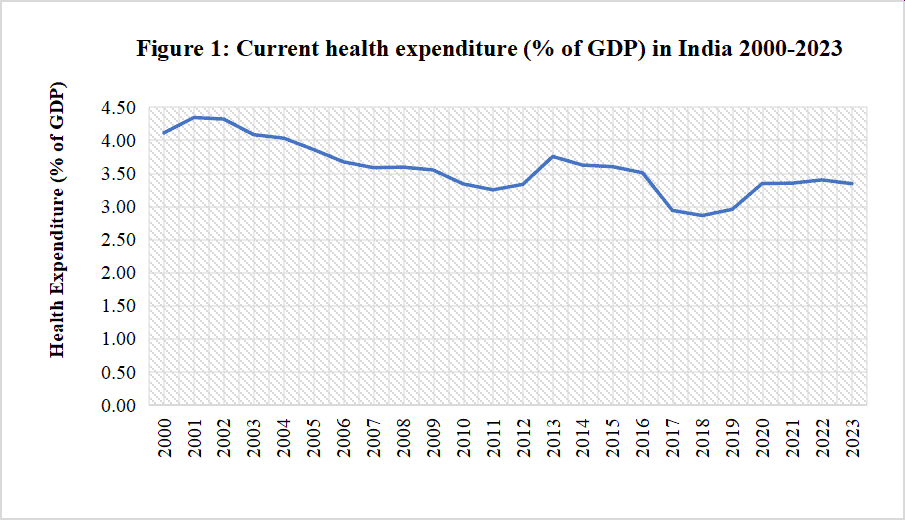
Source: World Bank Group, 2026
Healthcare Expenditure in Public and Private Hospitals
Public hospitals receive substantial subsidies but generally operate on limited budgets relative to population needs. Public health expenditure in India has consistently remained below 3 per cent of GDP, constraining improvements in infrastructure, staffing, and equipment (see Figure 1). In contrast, private hospitals charge for services and offer advanced technology and shorter waiting times; however, their fees are unaffordable for many families. As a result, a two-tier system has developed in which financial capacity determines the speed and quality of treatment, thereby intensifying social and economic disparities.
Extended Waiting Periods and Queues in Public Healthcare Facilities
Extended waiting periods are common in public hospitals for routine check-ups and specialised procedures, including surgeries and diagnostic scans. Patients often face delays of several weeks or months for scheduled treatments and prolonged waits for routine consultations. Persistent queues outside public hospitals highlight the imbalance between patient volume and available medical staff. Several factors contribute to these delays. Public hospitals often lack adequate staff to meet patient demand, and administrative inefficiencies, such as reliance on paper records and inadequate appointment systems, further exacerbate delays.
Table 1: Percentage distribution of hospitalisation cases (excluding childbirth) during the last 365-day period: All-India
| Age-Group | Percentage distribution of hospitalisation cases | |||||
| Rural | Urban | |||||
| Male | Female | Person | Male | Female | Person | |
| 0-4 | 9.6 | 6.0 | 7.9 | 7.5 | 6.3 | 6.9 |
| 5-.14 | 7.5 | 5.7 | 6.7 | 7.1 | 5.9 | 6.5 |
| 15-29 | 12.1 | 15.8 | 13.8 | 12.9 | 14.2 | 13.5 |
| 30-44 | 16.0 | 21.1 | 18.4 | 17.0 | 18.2 | 17.5 |
| 45-59 | 21.8 | 25.4 | 23.4 | 23.0 | 26.0 | 24.5 |
| 60+ above | 33.2 | 25.9 | 29.8 | 32.5 | 29.5 | 31.0 |
| Medical Institution | ||||||
| Govt. hospital/Public health facilities | 37.2 | 41.6 | 39.2 | 32.2 | 32.4 | 32.2 |
| Charitable/Trust/NGO run hospital | 2.9 | 2.9 | 2.9 | 3.1 | 3.2 | 3.2 |
| Private hospital (including Govt. empanelled | 59.9 | 55.5 | 57.9 | 64.7 | 64.4 | 64.6 |
Source: NSS Report No. 596: Household Social Consumption, 2025
The Ayushman Bharat initiative, launched in 2018, comprises two interlinked components: the Pradhan Mantri Jan Arogya Yojana (PM-JAY), which provides health insurance cover of ₹5 lakh per family per year to eligible beneficiaries, and Health and Wellness Centres (HWCs), now renamed Ayushman Arogya Mandirs (AAMs), which deliver comprehensive primary healthcare services. According to the National Statistical Office (2025), private hospitals are widely accessible in both rural and urban areas. Among individuals aged 15 to 59, females have higher hospitalisation rates than males in both settings. However, in the 60-and-above age group, males are hospitalised more frequently than females (see Table 1).
Table 2: Break-up of average medical expenditure (₹) (excluding childbirth) per hospitalisation case by its component across medical institutions during the last 365-day period
| Residence | Medical Institution | Break-up of components in average medical expenditure (₹) per hospitalisation case | ||||||
| Package component | Doctor’s/ surgeon’s fee | Medicine | Diagnostic tests | Bed charges | Other | All | ||
| Rural | Govt. hospital/ Public health facilities | 2,141 | 363 | 2,603 | 1,183 | 187 | 853 | 7,330 |
| Charitable/ Trust/NGO run hospital | 24,956 | 3,834 | 6,372 | 2,784 | 2,025 | 2,396 | 42,367 | |
| Private hospital (incl. Govt. empanelled) | 21,290 | 7,580 | 8,921 | 4,203 | 5,245 | 2,495 | 49,734 | |
| All | 13,884 | 4,640 | 6,368 | 2,977 | 3,167 | 1,848 | 32,884 | |
| Urban | Govt. hospital/ Public health facilities | 1,692 | 246 | 2,241 | 1,170 | 199 | 865 | 6,413 |
| Charitable/ Trust/NGO run hospital | 17,718 | 7,251 | 9,148 | 3,434 | 6,397 | 2,038 | 45,985 | |
| Private hospital (incl. Govt. empanelled) | 35,128 | 9,130 | 9,189 | 4,914 | 5,656 | 2,939 | 66,955 | |
| All | 23,799 | 6,206 | 6,948 | 3,660 | 3,920 | 2,242 | 46,774 | |
Source: NSS Report No. 596: Household Social Consumption, 2025
According to data from the NSSO 80th round (2025), individuals in both rural and urban areas incur higher costs for doctors’ or surgeons’ fees, medicines, and diagnostic tests in private hospitals and in charitable trust or NGO-run hospitals. In contrast, these costs are lower in government hospitals. However, increased patient demand, longer waiting times, and long queues in public hospitals often compel patients to seek care in private facilities. Strengthening public healthcare infrastructure, particularly in rural areas, is therefore essential (see Table 2).
Disparities in Healthcare Services: Demand and Supply
In sustainable healthcare, rising chronic disease prevalence, an ageing population, and heightened awareness are driving demand. However, public infrastructure has not scaled accordingly, leaving most people reliant on expensive private care and widening disparities in income, class and geography. About two-thirds of India’s population lives in rural areas, where healthcare resources are particularly scarce. Many PHCs and CHCs lack adequate staffing, equipment, and essential medicines. As a result, rural residents often travel to urban centres for basic medical care, increasing the burden on city hospitals. India’s growing population, longer life expectancy, and rising prevalence of chronic diseases have increased demand for healthcare services. However, this demand is unevenly distributed. Most hospitals and clinics are concentrated in urban and affluent regions, while individuals in hilly, tribal, and remote areas face restricted access. These disparities impede equitable and timely treatment. Rising demand for private healthcare has intensified pressure on private hospitals, driving up costs for treatment, diagnostics, and hospitalisation. This often requires out-of-pocket payments or private insurance, which remains inaccessible to a significant portion of the population.
Strengthening India’s Healthcare System
To strengthen the healthcare system, the National Health Policy (2017) stated that:
“the primary aim of this is to inform, clarify, strengthen and prioritise the role of the Government in shaping health systems in all its dimensions- investments in health, organisation of healthcare services, prevention of diseases and promotion of good health through cross-sectoral actions, access to technologies, developing human resources, encouraging medical pluralism, building knowledge base, developing better financial protection strategies, strengthening regulation and health assurance” (MoHFW, 2017).
The results presented in this piece suggest several recommendations to improve the quality of healthcare services, particularly in rural areas. Based on these findings, the following suggestions are proposed to strengthen the healthcare system.
- Strengthening institutional accountability mechanisms is essential to ensure that hospital management and administrative authorities provide consistent standards of care, regardless of patients’ socio-economic status or geographical location. This objective can be achieved by implementing transparent grievance redressal systems, conducting regular service delivery audits, and establishing standardised treatment protocols to prevent discretionary or discriminatory practices, particularly against economically vulnerable and rural populations.
- Improving the doctor-patient ratio is also a key effort to bridge the gap between the medical workforce and population needs and should be a government priority. Strategies include increasing admissions to medical colleges, offering financial and career advancement incentives for rural postings, and accelerating recruitment in public health institutions. Sustained workforce expansion is expected to reduce waiting times and consultation delays.
- Expanding specialised hospitals according to population density and regional disease burden is a key policy priority. This strategy would decentralise tertiary care, ease overcrowding in urban hospitals, and improve access to specialised treatment, thereby reducing unnecessary travel and delays for patients.
- Strengthening rural healthcare infrastructure is critical, as rural and economically disadvantaged populations bear a disproportionate burden of inadequate care. Enhancing primary and community health centres requires reliable access to medicines, diagnostic equipment, and trained personnel, as well as implementing telemedicine to overcome accessibility challenges in remote areas. Together, these strategies, including infrastructure expansion, equitable governance, workforce development, and targeted rural health investment, form a comprehensive policy framework to address systemic disparities and promote a more resilient and inclusive healthcare system in India.
Concluding Observations: A Policy Note
Historically, inadequate public health investment led to fragmented service delivery, significant urban-rural disparities, and elevated out-of-pocket expenditure. The National Rural Health Mission (2005) expanded primary healthcare in underserved rural areas through community health workers (ASHAs) and decentralised planning. The National Health Policy (2017) shifted the focus towards universal health coverage, preventive care, and higher public health spending targets. Ayushman Bharat (2018), comprising Health and Wellness Centres and the PM-JAY insurance scheme, addressed both access to primary care and catastrophic health expenditure among economically vulnerable populations. The National Digital Health Mission (2020) established interoperable digital health records, thereby improving continuity of care and overall health system efficiency.
To meet evolving healthcare demands, three primary actions require attention. First, integrating existing initiatives, including the National Rural Health Mission (NRHM), Ayushman Bharat, and the National Digital Health Mission (NDHM), into a unified system would minimise programme overlap, optimise resource allocation, and ensure continuity of care across all levels. Second, increased investment in human resources and infrastructure is essential to align with policy objectives. This includes establishing additional institutions such as the All-India Institute of Medical Sciences (AIIMS), incentivising medical professionals to serve in rural areas, and strengthening the health workforce in underserved areas. Third, sustained public health funding and robust digital infrastructure should underpin future reforms. Together, these measures can facilitate India’s transition from temporary solutions to a sustainable, rights-based healthcare system.
References
Ministry of Health and Family Welfare (2017). National Health Policy 2017. Government of India. Retrieved from https://nhsrcindia.org/sites/default/files/2021-07/National%20Health%20Policy%202017%20%28English%29%20.pdf
Ministry of Health and Family Welfare. (2005). National Rural Health Mission: Meeting people’s health needs in rural areas: Framework for implementation 2005-2012. Government of India. Retrieved from https://nhm.up.gov.in/assets/site-files/Mission-Document.pdf
National Health Authority. (2018). Ayushman Bharat Pradhan Mantri Jan Arogya Yojana. Government of India. Retrieved from https://nhsrcindia.org/sites/default/files/2021-03/Operational%20Guidelines%20For%20Comprehensive%20Primary%20Health%20Care%20through%20Health%20and%20Wellness%20Centers.pdf
National Health Authority. (2020). National Digital Health Mission. Government of India. Retrieved from https://www.niti.gov.in/sites/default/files/2023-02/ndhm_strategy_overview.pdf
National Statistical Office, Ministry of Statistics and Programme Implementation, Government of India. (2025). Household social consumption: Health (NSS Report No. 596). Retrieved from https://www.mospi.gov.in/uploads/publications_reports/publications_reports1776676412084_2b4f2b5c-2f1c-446b-8fa3-ec8f125b2b66_Final_Report_no_596_Health_(2).pdf
Press Information Bureau (2025). Measures taken to Increase Availability of Doctors. Ministry of Health and Family Welfare. Retrieved from https://www.pib.gov.in/PressReleasePage.aspx?PRID=2245966®=48&lang=2
Press Information Bureau (2026). Update on Health Workforce Availability in Public Health Facilities. Ministry of Health and Family Welfare. Retrieved from https://www.pib.gov.in/PressReleasePage.aspx?PRID=2225755®=48&lang=2
World Bank Group (2026). Current health expenditure. Retrieved from https://data.worldbank.org/indicator/SH.XPD.CHEX.GD.ZS?locations=IN