
Abstract
Unpaid household and care work plays a vital role in supporting families’ and the economy’s well-being, but is undervalued and inequitably distributed in Bangladesh. Women do 7.3 times more unpaid domestic and care work than men in the 2021 Time Use Survey. According to the Household Production Satellite Account for 2025, total unpaid household production in the year 2021 was estimated at BDT 6.673 trillion, which represents 18.9 percent of Gross Domestic Product (GDP), with women contributing 85.37 percent of the total estimated value. These are the sizes of these areas of unpaid work and do not alter the arrangements for care. This article is based on national statistical evidence and research undertaken in Bangladesh to explore how recognition can help to inform policy in practice. It calls for three key demands: quantification of unpaid work, the minimisation of avoidable care demands and the fair redistribution of unavoidable care demands. To do this, it is imperative to have social protection, availability of care services, employment policy, public investment and institutional coordination.
Keywords: Unpaid care work, Bangladesh, time use, Gender equality, Social protection, childcare
1. Introduction
All the households are reliant on work that many people do not consider work. Performing cooking, cleaning, gathering household necessities, taking care of children, and supporting older adults or family members who are physically disabled takes time and effort. Much of this is non-monetary and is not accounted for in the traditional frameworks of economic activity. However, its lack of a wage does not imply that it is socially and economically insignificant.
Domestic/care work in Bangladesh is gendered and women are the victims of it. Bangladesh National Time Use Survey (TUS), 2021 was carried out with the support of UN Women by Bangladesh Bureau of Statistics (BBS). The results indicate that women have seven times the workload of men with respect to unpaid work for domestic and care work (BBS & UN Women, 2023; UN Women, 2024). This disparity is a result of unequal daily activities to sustain families.
The study of household labor in Bangladesh provides a partial understanding of why household labor has to be treated as an issue of individual choice. Islam and Sharma (2021) conducted a study on unpaid activities of the rural household and Afrin and Saifullah (2024) focused on gender-based division of household labour in two districts. Heintz et al. (2018) studied the influence of cultural norms and economic motivations on women’s labour market activity. In combination, these studies highlight the connection between home duties and social expectations and women’s economic opportunities.
Another milestone was achieved in 2025 when Bangladesh released its Unpaid Household Production Satellite Account. The value of unpaid household production estimated from the 2021 TUS was BDT 6.673 trillion or 18.9 per cent of gross domestic product (GDP). The estimated value was higher for females (85.37 per cent) than males (Bangladesh Bureau of Statistics [BBS] et al., 2025). This is a combined indicator of unpaid household production in various components such as nutrition, housing, clothing, care and transport. It is not to be read as the value of unpaid care per se, or as an amount that is automatically included in GDP.
These developments make for a more robust evidence base to guide policy. The issue now isn’t just whether or not unpaid work should be recognised, but how it can contribute to a more equitable allocation of care. This article suggests that Bangladesh must link measurement to two additional priorities: to decrease unnecessary care demands and to re-distribute required care demands.
2. What the Evidence Tells Us
Use time-use data to complement employment statistics to capture activities that cannot be adequately represented by employment statistics. They provide information on how time is spent on paid work, home duties, care and education, and leisure. The 2021 survey offers a national-level analytical framework to analyze these trends, and the satellite account offers an economic estimate of unpaid household production (BBS & UN Women, 2023; BBS et al., 2025).
The gender difference of 7.3 times the duration of unpaid domestic and care work of women compared to men is important since time is finite. With predominantly one group taking on the majority of household duties, members of this household group may have less time to devote to paid work, education, training, leisure, and public life. The impact varies from household to household and national averages do not necessarily reflect the experiences of all women. However, they also show that there is a significant gender gap (UN Women, 2024).
Research provides additional context to these findings on the national level. Islam and Sharma (2021) studied the unpaid work in the rural households of Bangladesh, and Afrin and Saifullah (2024) studied the gender division of labor in the rural households of some districts. Heintz et al. (2018) examine the links between cultural norms and economic incentives and women’s labor market behavior. These studies would answer other questions and rely on other evidence and should not be considered interchangeable. But in tandem with the TUS, they argue for the importance of taking into account the social expectations as well as household situations when creating care policy.
There is a point of intersection between responsibilities for care and economic participation: in the case of childcare. In 2018, Taş and Ahmed conducted a survey in low-income neighborhoods in Dhaka to explore the link between childcare facilities and time allocation between work and play, and women’s economic engagement. Their study revealed that the participation of women in the labor market was negatively associated with child age, as women with children (0-5 years old) were less likely to participate in employment, or employment as an earner, compared to women with no children and women with children (6 years and older). Women with the youngest children who lacked child care were most affected by the labor-market cost. The findings show the importance of the provision of childcare, but not whether childcare is the only factor affecting women’s employment.
What’s missing is the satellite account. It makes a significant contribution in monetary terms by estimating the value of unpaid household production. However, valuing in monetary terms is not identical to the valuation of each member of the household for each one of his/her tasks. It has immediate policy relevance in that it aids decision-makers in understanding the size of activity that traditional economic measures are not necessarily able to adequately measure.
Table 1. Principal sources and their contributions to understanding unpaid work in Bangladesh
| Source | Evidence or focus | Relevance for policy |
| BBS and UN Women (2023); UN Women (2024) | National time-use evidence; women spend 7.3 times as much time as men on unpaid domestic and care work | Establishes the gender gap in the allocation of time |
| BBS et al. (2025) | Estimated unpaid household production of BDT 6.673 trillion, or 18.9% of GDP; women account for 85.37% of its estimated value | Shows the scale of unpaid household production and its unequal distribution |
| Islam and Sharma (2021) | Unpaid activities in rural Bangladesh households | Draws attention to household circumstances and the social context of unpaid work |
| Afrin and Saifullah (2024) | Gender-based division of household labour in selected districts | Provides Bangladesh-specific evidence on the distribution of household tasks |
| Heintz et al. (2018) | Cultural norms, economic incentives and women’s labour-market behaviour | Shows why employment outcomes must be considered alongside social expectations |
| Taş and Ahmed (2024) | Childcare access, time use and women’s economic participation in low-income Dhaka neighbourhoods | Supports consideration of accessible childcare in employment and care policy |
Source: Compiled by the author from the cited publications. The studies use different methods and populations; their findings are not directly interchangeable.
3. Why Recognition Is Not Enough
While measurement is an important initial task, it doesn’t necessarily change the family structure. A national survey might be used to record a woman’s unpaid work and provide an estimated monetary value of that work for the day, but the woman is still responsible for the same unpaid work. Changing the conditions of care is needed to reduce inequality, whilst recognition is needed to change public understanding.
This is especially important for working women who have unpaid duties. Heintz et al. (2018) explain the importance of considering economic incentives and cultural norms to comprehend women’s labor-market behavior. To promote the employment of women without addressing the distribution of domestic work may lead to the addition of paid work to women’s existing burden of work rather than an increase in women’s choices.
This is seen in childcare. Low-income neighborhoods in Dhaka show links between youth childcare and worse outcomes for women in the labor market, with childcare support being unavailable (Taş & Ahmed, 2024). Easy and reliable access to care can help address one factor of inequity, but won’t solve all inequities. Other factors, including work schedules, transportation, and family expectations about how family will cover for one another, as well as availability of services, also play a role in how families deal with caring.
The policy challenge is thus bigger than the recognition of women’s contribution or their rehabilitation in generating income. It’s about making care easier to provide, providing essential support, and helping to ensure greater sharing of responsibilities between women and men, and between families, employers, communities, and the state.
4. Where Policy Needs to Change
4.1 Social protection and time poverty
Social protection supports households in dealing with poverty, income insecurity, and vulnerability. But for individuals with significant care needs, financial support is not the only thing that can solve time-related issues. A family can obtain assistance and still have no access to affordable childcare, no access to health services, or no access to assistance for family members of older age and/or disability.
Current programs should be evaluated to see if participation is unduly hindered by eligibility criteria, application process, program timelines, or participation requirements for caregivers. In some instances, it may be more feasible to make adaptations to existing programs than develop a program for each need that relates to care. Program design should consider those who are most likely to be unable to access support from their employer or private services.
4.2 Affordable childcare and other care service
Families need affordable and reliable child care to manage care and to be able to attend work or school. Services must be available to people with low incomes and not in formal employment, who may not be able to access facilities provided by their employers. All of this can be provided through public, community, workplace and suitably regulated private provision.
Also, in the care policy, older citizens, disabled people and other individuals who require regular care and attention should be taken into consideration. This is not to say that families should not be replaced or that all families need the same type of service. It is about making sure that families don’t have to address each of their needs without any real support to do so.
Basic infrastructure is also a concern. If access to water, sanitation, transport, or health services is challenging, households will need to invest more time in visits to obtain the required services or in traveling to access the services. These expenditures can be a form of investment in services that can be part of a care policy around reducing avoidable demands on the household’s time, even if the money is not spent on the specific purpose of a care policy.
4.3 Employment policy
People with family responsibilities may find paid work challenging due to the number of hours required, inflexible work hours, and limited leave opportunities. Depending on the nature of the job and workers’ circumstances, reasonable flexibility, maternity protection, family-related leave, and childcare support may help.
These measures shouldn’t be created exclusively for women. Whereas family leave and care responsibilities are perceived as largely women’s issues, policies may reinforce the assumption of women as the default carer. Promoting family-related leave and involvement in day-to-day care is also crucial.
However, a formal workplace benefits system cannot be equally available to all workers in a labor market where there is significant informal work. Unstable workers, workers who are not supported by employers in providing homes, etc., should be taken into account in service planning. Formal workplaces are not the only places where access can be extended through publicly supported and community-based services.
4.4 Gender-responsive budgeting
Gender-responsive budgeting provides an opportunity to assess public expenditure through a care perspective. When looking at budget proposals, consider the following: Does the budget provision decrease household time to provide for essential needs? Does the budget provision increase access to care services or ease the burden on household responsibilities?
Social, economic and human capital investment in childcare, water, sanitation and transport could help to alleviate unpaid work, even if this is not considered a care cost. Social, economic and human capital investments in water, sanitation and transport could help to alleviate unpaid work, even if these are not considered care costs. The HPSA provides valuable economic context, but should not be viewed as an absolute measure of the savings or benefits that can be attributed to a specific investment.
Budget assessments must be based on real-world results – will services be available for more people, will waiting times be reduced, will the quality of services be enhanced, will the responsibilities shared between women and men be fairer? These questions would make the budget links more relevant to people’s daily lives.
4.5 Institutional coordination
Unpaid care spans the area of public agency tasks relating to social security, women and children, health, education, labor, local government, and finance. Without coordination from these institutions, services can be disconnected, and critical needs can even be overlooked between the multiple administrative functions.
A coordinated approach should help determine who is expected to be responsible for what aspects of financing, service delivery, monitoring, and public reporting. National statistics can help to guide planning, and local institutions and service providers can help determine gaps in access. Where appropriate, employers, community organizations and those using care services should be involved.
The goal of coordination is not to increase the number of meetings or plans; it is to produce results. This should be explored in regular reporting in terms of the extent to which services are meeting the needs of those who are not served, as well as the extent to which policy changes are reducing time pressures in care.
5. From Recognition to Action
The key priorities to make a growing evidence base into a concrete program of action for Bangladesh are threefold and interrelated: recognition, reduction, and redistribution.
The first is to maintain the measurement of unpaid work. Time-use surveys should be conducted at regular intervals (when appropriate) and conducted in a consistent manner, if possible, to be able to compare changes over time. Analysis should be undertaken by sex and appropriate characteristics – age, location, employment status, household circumstances. Repeated measurement would allow us to find out where time constraints are highest, and if policy interventions are having an impact or not.
Secondly, assist in minimizing unnecessary care responsibilities. Childcare, and possibly services for older people and others requiring assistance, should be made affordable and a priority for public policy. Planning should consider local needs, not just facilities, and be based on the need for safety and quality as well as affordability. Reliable water supplies, sanitation, transport, and health services also should be taken into account, as they can contribute to unpaid domestic work if there are gaps in basic services.
Thirdly, redistribute needed attention more equitably. Social protection programs should be examined to determine if the processes or delivery mechanisms of the programs have the potential to harm those with significant care responsibilities. Where applicable, leave and flexible working arrangements should apply to men as well as women relating to family issues. The concept that care is a responsibility shared by everyone—not just the responsibility of women—can be reinforced by public communication, education and workplace practices.
These priorities should be connected, and not viewed as individual tasks. Measurement should be used to better inform service planning; accessible services should make it easier to share the necessary care; and monitoring should determine if changes are positive for the people who need them. Progress should be measured in real terms, for example, in terms of access to services, the time it takes to access essential services, and changes in unpaid work distribution. Target setting should only be based on information gained during the baseline and institutional capacity assessment.
Figure 1. A policy framework for moving from recognition to redistribution
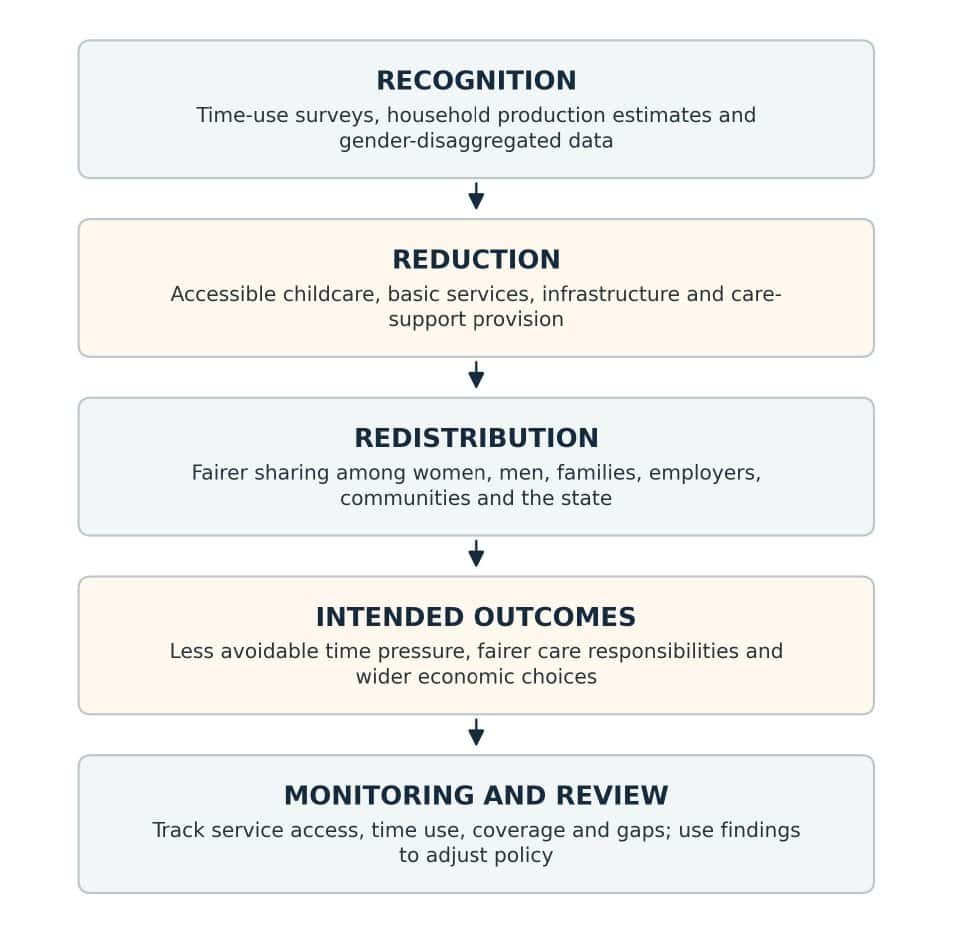
Findings inform the next round of measurement and policy planning
Source: Author’s conceptual framework, developed from the evidence and policy analysis in this article. The figure presents a proposed sequence for policy action; it is not an empirical model or a claim that outcomes occur automatically.
The framework makes a practical distinction. Recognition establishes the scale and distribution of unpaid work. Reduction concerns avoidable demands created by inadequate services and infrastructure. Redistribution addresses who performs the care that remains necessary. Monitoring helps determine whether policies are working and where adjustments are needed. The process is iterative: monitoring findings should inform subsequent measurement and policy planning.
6. Conclusion
Bangladesh is making good progress in capturing unpaid domestic and care work. These differences in the use of time are highlighted in the 2021 time use survey, and the Household Production Satellite Account of 2025 estimates the economic value of the total unpaid household production. Research on the household’s labor force, social norms regarding labor, and women’s employment and childcare in Bangladesh to provide context.
These accomplishments are a basis and not entirely a policy response. Improved statistics won’t alleviate women’s unpaid work, and promoting women to paid work won’t solve inequality if there is no change in women’s care tasks. To move forward, it is necessary to take coordinated action on social protection systems, affordable care, employment arrangements, public infrastructure, budgeting, and institutional coordination.
Unpaid care is not just the personal responsibility of individual families or women. It is an integral part of family functioning, the way in which economic opportunities are accessed and the distribution of the costs of maintaining daily living. Next, Bangladesh must leverage its evidence to minimize unnecessary burdens and enable more equitable access to essential care. Recognition is meaningful when it informs the decision-making process, reduction when it relieves unnecessary demands, and redistribution when it makes the distribution of care more equitable.
References
Afrin, S., & Saifullah, M. K. (2024). Gender-based division of household labor: A study of selected districts of Bangladesh. International Journal of Social Economics, 51(12), 1615–1628. https://doi.org/10.1108/IJSE-03-2023-0195
Bangladesh Bureau of Statistics, & UN Women. (2023). Bangladesh time-use survey 2021. Bangladesh Bureau of Statistics. https://data.unwomen.org/publications/bangladesh-time-use-survey-2021
Bangladesh Bureau of Statistics, UN Women, & Asian Development Bank. (2025). Unpaid household production satellite account of Bangladesh: Based on Time Use Survey 2021. Bangladesh Bureau of Statistics. https://bangladesh.un.org/en/301684-unpaid-household-production-satellite-account-bangladesh
Heintz, J., Kabeer, N., & Mahmud, S. (2018). Cultural norms, economic incentives and women’s labour market behaviour: Empirical insights from Bangladesh. Oxford Development Studies, 46(2), 266–289. https://doi.org/10.1080/13600818.2017.1382464
Islam, F. B., & Sharma, M. (2021). Gendered dimensions of unpaid activities: An empirical insight into rural Bangladesh households. Sustainability, 13(12), Article 6670. https://doi.org/10.3390/su13126670
Taş, E. O., & Ahmed, T. (2024). Women’s economic participation, time use, and access to childcare in urban Bangladesh. Forum for Social Economics. Advance online publication. https://doi.org/10.1080/07360932.2024.2422955
UN Women. (2024). Summary brief: Bangladesh time-use survey 2021. https://data.unwomen.org/publications/summary-brief-bangladesh-time-use-survey-2021