How to Find and Apply for PhD Positions in Norway: A Complete Guide for Global South Applicants
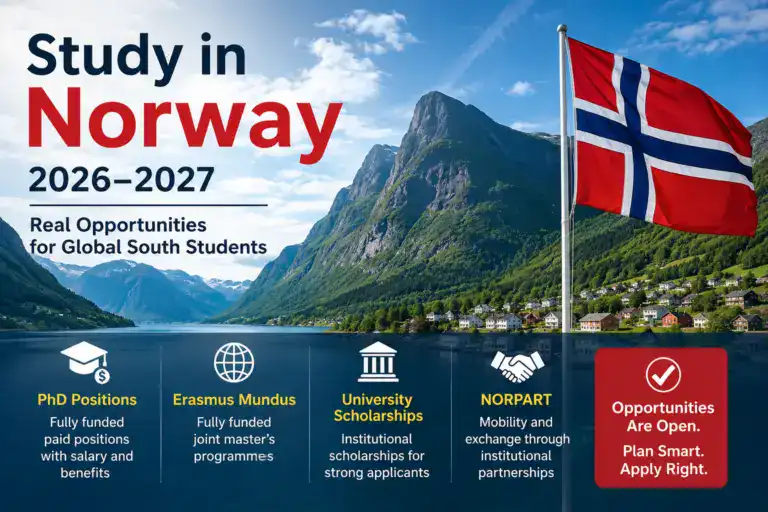
PhD positions in Norway are fully funded, paid employment. Candidates receive a salary of NOK 530,000–580,000 per year, full employment benefits, and zero tuition. Positions are open to all nationalities and advertised year-round. This guide explains exactly how Global South applicants can find, apply for, and secure a funded PhD position in Norway in 2026.
If you want to study in Norway with full financial support in 2026, a PhD position is the most realistic and open path available. It is not a scholarship — it is better than one. This guide covers everything you need to know. Read More
Quick Overview
| Detail | Information |
|---|---|
| Opportunity Type | Paid employment (PhD Research Fellow) |
| Salary | NOK 530,000–580,000/year (~EUR 46,000–51,000) |
| Tuition | None — PhD candidates are university employees |
| Duration | Typically 3–4 years |
| Open To | All nationalities |
| Application | Applied to individual positions — no central portal |
| Deadline | Rolling — new positions advertised year-round |
| Primary Job Portal | jobbnorge.no |
What Is a PhD Position in Norway?
In Norway, PhD candidates are not students who pay fees and receive stipends. They are university employees. When you are accepted into a funded PhD position, you sign an employment contract with the university, receive a full Norwegian salary, pay into the national pension system, and have access to Norway’s public healthcare. Tuition does not apply because you are staff.
This model is standard across Scandinavian countries and is one of the most generous research training arrangements in the world. The salary — approximately NOK 530,000–580,000 per year — is enough to live comfortably in Norway, though the country’s high cost of living means it is not a surplus income.
PhD positions are funded through research grants, government allocations, and industry partnerships. Universities advertise positions as they receive funding, which means new opportunities appear throughout the year, not just at one annual deadline.
Top Norwegian Universities for International PhD Applicants
University of Oslo (UiO) — Norway’s oldest and largest university. Strong in humanities, social sciences, law, medicine, mathematics, and natural sciences. Regularly advertises PhD and postdoctoral positions. Oslo is Norway’s capital with the most international infrastructure.
NTNU — Norwegian University of Science and Technology — Located in Trondheim, NTNU is Norway’s leading technical university with particular strength in engineering, computer science, marine technology, energy, and architecture. Has strong industry ties with companies like Equinor, Hydro, and Kongsberg, which co-fund some positions.
University of Bergen (UiB) — Known internationally for marine science, climate research, global health, and the humanities. Bergen is Norway’s second city and a UNESCO World Heritage site.
University of Tromsø (UiT — The Arctic University of Norway) — Specialises in Arctic research, indigenous studies, fisheries, marine biology, and health sciences. Located above the Arctic Circle, it offers a unique research environment.
Oslo Metropolitan University (OsloMet) — Focused on applied sciences, social work, nursing, education, and urban studies.
Peace Research Institute Oslo (PRIO) — A leading international institute for peace and conflict studies. Regularly advertises PhD and researcher positions relevant to Global South academics.
Fields With Active PhD Positions for Global South Applicants
Norwegian universities are particularly active in hiring PhD candidates in these areas:
- Artificial intelligence and machine learning
- Climate science and environmental research
- Marine science and ocean technology
- Global health and public health
- Development studies and peace research
- Renewable energy and sustainable technology
- Social sciences and policy studies
- Computational biology and genomics
- Education and pedagogy
PRIO, UiO, and UiB in particular regularly advertise positions with explicit relevance to development, Global South contexts, and international collaboration — making them especially relevant for applicants from developing countries.
Where to Find Open PhD Positions — Step by Step
Step 1: Jobbnorge.no This is Norway’s official academic jobs platform. All Norwegian universities post PhD and postdoc positions here. Go to jobbnorge.no, filter by “PhD” and your research field or subject area, and set up email alerts for new listings.
Step 2: University Research Pages Go directly to your target university’s website and navigate to their “vacant positions” or “research positions” section. New positions are posted as funding becomes available — check regularly.
Step 3: ScholarshipDB scholarshipdb.net/phd-scholarships-in-Norway aggregates currently advertised Norwegian PhD positions. As of May 2026, there are hundreds of active listings across disciplines.
Step 4: Euraxess euraxess.ec.europa.eu lists research positions across Europe, including Norway. Many Norwegian PhD positions are cross-posted here.
Step 5: Research Group Websites Identify two or three research groups in Norway working in your specific field. Follow their news pages. Some positions are filled through direct outreach from motivated candidates before they are ever formally advertised. A well-researched email to a professor whose work aligns directly with yours is a legitimate strategy.
Eligibility Requirements
Requirements vary by position but the following apply to most Norwegian PhD roles:
- A relevant Master’s degree (or equivalent) in the field — most positions require this before the start date
- Strong academic record demonstrating research capability
- English language proficiency (most programmes are in English; proof such as IELTS or TOEFL may be required)
- A clear research proposal or statement of purpose relevant to the position’s described project
- Two or three academic reference letters
- Open to all nationalities — there are no country restrictions on PhD positions
Some positions, particularly those funded by specific research projects, require background in a very specific area. Read the job description carefully and only apply if your research experience genuinely matches.
How to Write a Winning Application
Norwegian PhD applications are job applications, not scholarship applications. The mindset and approach are different.
Read the position description in full. Understand exactly what research the project involves. Your application must speak directly to that project — generic applications are disregarded immediately.
Tailor your research statement. Write a 1–2 page research statement that connects your previous work and research interests directly to the specific project described. Show that you understand the research problem and have relevant skills or experience.
Demonstrate research output. Publications, conference presentations, theses, and research reports all strengthen your application. Even a strong Master’s thesis on a related topic is meaningful evidence.
Contact the supervisor first. Before submitting, email the potential supervisor (usually named in the position description). Introduce yourself briefly, explain your research background, and ask if they think your profile is a good fit. A positive response before applying significantly improves your chances.
References matter. Choose referees who can speak to your research ability specifically — not just your academic performance. A referee who has supervised your research carries more weight than a course teacher.
Visa Requirements for Non-EU/EEA Students
Non-EU/EEA students accepted for a PhD position in Norway need a work and residence permit, not a student visa — because they are employees.
- Apply for a residence permit for skilled workers at the Norwegian Directorate of Immigration (UDI): udi.no
- You will need your employment contract from the university as the primary document
- Processing time can take several weeks — apply as early as possible after receiving your offer
- The Norwegian government reduced the financial requirement for PhD candidates to NOK 80,000 (approximately USD 8,000) in June 2025, making visa processing more accessible
Practical Realities of Living in Norway as a PhD Candidate
Norway is not cheap. A PhD salary covers living costs comfortably but is not lavish given the country’s cost of living. Plan for:
- Accommodation: NOK 6,000–12,000/month depending on city and type
- Food: NOK 3,000–5,000/month
- Transport: NOK 700–1,500/month
- Healthcare: Covered as an employee
- Pension: Automatically deducted from salary
Oslo is the most expensive city. Tromsø and smaller university towns are more affordable. Many universities have student housing that PhD candidates can access.
Frequently Asked Questions
Are PhD positions in Norway open to applicants from developing countries? Yes. PhD positions are employment opportunities open to all nationalities. There are no country restrictions. What matters is your academic and research qualifications relative to the position’s requirements.
Do I need to speak Norwegian for a PhD position? Most PhD positions at Norwegian universities are in English. The Norwegian government removed the Norwegian-language requirement for positions at higher education institutions in June 2025. Norwegian language skills are not required to work as a PhD candidate, though they are useful for daily life and for post-doctoral employment prospects.
How competitive are Norwegian PhD positions? Very competitive for popular fields and prestigious positions. Less competitive for niche or technical research areas where specialised skills are rare. A direct approach to supervisors before applying — combined with a publication record or strong Master’s thesis — significantly improves chances.
How long does a PhD take in Norway? Typically 3 years for the PhD itself, sometimes 4 years if teaching duties are included. The employment contract specifies the exact duration.
Can I bring family to Norway on a PhD position? Yes. As an employee, you can apply for family reunion permits for dependents. Norway has good family support systems including public childcare and parental leave.
Is it possible to stay in Norway after completing a PhD? Yes. Norway actively seeks to retain PhD graduates. After completing your doctorate, you can apply for a skilled worker residence permit if you have a job offer. Many Norwegian PhD graduates continue as postdocs or researchers at the same or other institutions.
Where to Apply:
- jobbnorge.no — Official Norwegian academic jobs portal
- euraxess.ec.europa.eu — European research positions including Norway
- ntnu.edu/vacancies — NTNU positions
- uio.no/english/about/jobs — University of Oslo positions
- uib.no/en/about/employment — University of Bergen positions