Study in Norway 2026–2027 | What Has Changed and What Opportunities Are Actually Open
Norway changed its education policy in 2023. Most international students from outside the EU/EEA now pay tuition fees at Norwegian public universities. The flagship Quota Scheme closed in 2016. NORSTIP was cancelled in 2026. If you are researching Norway scholarships in 2026, this guide tells you exactly what is real, what is gone, and what paths remain genuinely open for Global South students.
If you have been reading “25 Fully Funded Scholarships in Norway” articles, stop. Most of them list programmes that no longer exist. This article will not do that. Read it fully before you apply or plan.
Quick Overview
| Detail | Current Status (2026) |
|---|---|
| Tuition for non-EU/EEA students | Introduced in 2023; most universities charge fees |
| Norwegian Quota Scheme | Ended 2016 — not accepting new applicants |
| NORSTIP | Cancelled from 2026 budget |
| PhD positions | Fully funded as paid employment — open to all nationalities |
| Exchange students | Still tuition-free |
| EU/EEA students | Still tuition-free at public universities |
| University autonomy on fees | From June 2025, each university can set its own policy |
What Changed in 2023 — And Why It Matters
Norway was tuition-free for all international students, including those from developing countries, until August 2023. That year, the Norwegian parliament voted to introduce cost-covering tuition fees for non-EU/EEA students. The impact was immediate and severe: international enrolment from non-European countries dropped by approximately 80 percent within two years.
For the 2025–2026 academic year, non-EU/EEA students pay between NOK 80,000 and NOK 260,000 per year (approximately EUR 7,000–23,000) depending on the university and programme — this is on top of Norway’s already high living costs, which typically run NOK 120,000–180,000 per year (approximately EUR 10,500–15,800).
In June 2025, the Norwegian government partially reversed course. It announced that individual universities can now decide whether to charge international students tuition or not. This means the situation varies by university and is changing. Always check directly with your target institution for 2026–2027 fee policies.
What Opportunities Are Genuinely Open for Global South Students in 2026
1. PhD Positions — The Best Option Available
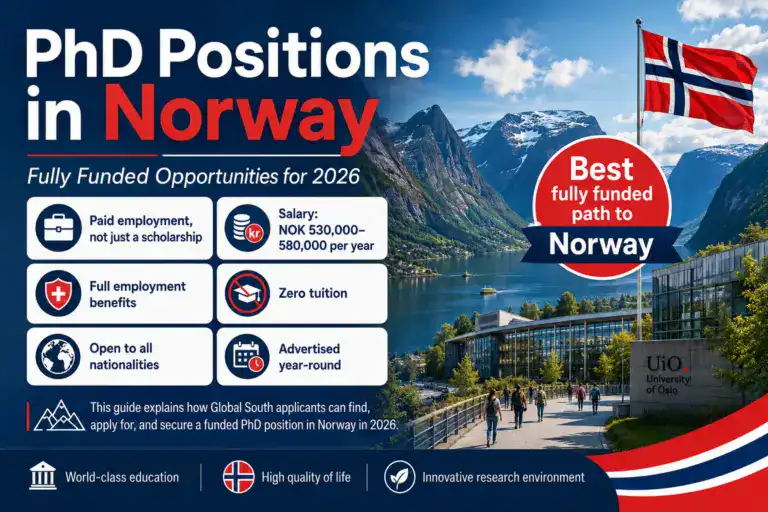
This is the most important thing to understand about Norway: PhD positions are paid employment, not scholarships. If you secure a PhD position at a Norwegian university, you are hired as a university employee with a full salary, pension, and benefits. There is no tuition because you are staff.
PhD salaries at Norwegian universities typically range from NOK 530,000–580,000 per year (approximately EUR 46,000–51,000). This is not a stipend — it is a real salary with employment rights. PhD positions are open to applicants of all nationalities and are actively advertised year-round.
As of May 2026, hundreds of funded PhD positions are open at Norwegian universities including the University of Oslo, NTNU (Norwegian University of Science and Technology), and the University of Bergen, across fields including computer science, AI, environmental science, marine science, global health, humanities, and social sciences.
This is the most realistic fully funded path to study in Norway for Global South applicants in 2026.
2. Erasmus Mundus Joint Masters
Norway participates in Erasmus Mundus Joint Master programmes — prestigious fully funded joint degrees run by consortiums of European universities. If you are admitted to an Erasmus Mundus programme that includes a Norwegian university as a partner, you may study in Norway as part of that programme, fully funded. These are highly competitive but genuinely open to Global South applicants.
3. University-Specific Scholarships
Some Norwegian universities offer institutional scholarships for strong international applicants. These vary by institution and are not standardised. Check the scholarship pages of your target university directly. Examples include NTNU’s externally funded PhD and research positions, and the University of Bergen’s doctoral fellowships.
4. NORPART (Norwegian Partnership Programme)
NORPART funds mobility and exchange between Norwegian higher education institutions and institutions in developing countries. This is an institutional programme — it requires your home university to have a cooperation agreement with a Norwegian university. Individual students cannot apply independently. Contact your home institution’s international office to find out if a NORPART partnership exists.
What Is No Longer Available — Be Warned
Norwegian Government Quota Scheme: Closed to new admissions since 2016. Despite this, hundreds of websites still list it as active for 2026 and 2027. It is not. Do not plan around it.
NORSTIP: A scheme established in 2023 specifically to offset the new tuition fees for developing country students. It lasted barely two years and was cancelled from the 2026 budget.
If a website tells you the Quota Scheme is open for 2027 applications, that website has not been updated and its information is a decade out of date.
Living Costs in Norway — The Honest Numbers
Even if tuition is covered, Norway is one of the most expensive countries in Europe. Budget accordingly:
- Monthly living costs: NOK 10,000–15,000 (EUR 870–1,300)
- Annual total living costs: NOK 120,000–180,000 (EUR 10,500–15,800)
- This includes accommodation, food, transport, and daily expenses
Without a fully funded PhD salary or a comprehensive scholarship, Norway is financially very difficult for students from developing countries.
Who Should Seriously Consider Norway in 2026
Norway is a strong option if you fall into one of these categories:
- You have a strong research profile and can compete for funded PhD positions at Norwegian universities
- Your home institution has a NORPART agreement with a Norwegian university
- You are applying for an Erasmus Mundus programme that includes Norwegian partner universities
- You are an exchange student through your home institution’s bilateral agreement with a Norwegian university
If you do not fit one of these categories, Norway in 2026 is not a financially viable destination for most Global South students without independent funding.
How to Find Open PhD Positions in Norway Right Now
- Visit jobbnorge.no — Norway’s main academic job portal where universities post PhD and postdoc positions
- Visit scholarshipdb.net/phd-scholarships-in-Norway — aggregates currently advertised positions
- Go directly to the research positions pages of: University of Oslo (uio.no), NTNU (ntnu.edu), University of Bergen (uib.no), University of Tromsø (uit.no)
- Set up Google Alerts for “PhD position Norway [your field]” to catch new postings
- Contact research groups working in your field directly — many positions are filled through proactive outreach before they are even advertised
Frequently Asked Questions
Is Norway still free for international students in 2026? Not universally. EU/EEA students still study for free. Non-EU/EEA students face tuition fees at most public universities following the 2023 policy change, though from June 2025 individual universities can choose their own fee policy. PhD positions remain tuition-free because PhD candidates are hired as university employees, not enrolled as fee-paying students. Always verify directly with your target institution.
Is the Norwegian Quota Scheme still open? No. The Quota Scheme closed to new admissions in 2016. Any website listing it as active for 2026 or 2027 is using outdated information. Do not apply for it or plan your studies around it.
Can I get a fully funded opportunity in Norway as a Global South student? Yes — but primarily through PhD positions, which are paid employment. This is genuinely the best and most accessible fully funded path to Norway for international applicants in 2026.
What is the monthly salary for a PhD position in Norway? PhD positions at Norwegian universities typically pay NOK 530,000–580,000 annually (approximately EUR 46,000–51,000), paid monthly as a salary with full employment benefits.
Do I need to speak Norwegian to study in Norway? For PhD positions and most Master’s programmes, English is sufficient. The Norwegian government also removed the Norwegian-language requirement for positions at higher education institutions in June 2025, making it easier for international PhD candidates to apply.
What is NORPART? NORPART is the Norwegian Partnership Programme for Global Academic Cooperation. It funds exchange and mobility between Norwegian universities and partner institutions in developing countries. Students can only access it through their home institution’s partnership agreement — individual applications are not possible.
Official Resources:
- jobbnorge.no — PhD and academic positions
- ntnu.edu/research/phd — NTNU PhD positions
- uio.no/english/research/phd — University of Oslo PhD
- uib.no/en/phd — University of Bergen PhD
- hkdir.no — Norwegian Directorate for Higher Education and Skills
Last updated: May 2026. Norway’s higher education policy is actively changing. Always verify current tuition fee policies, English requirements, and scholarship availability directly with your target institution before applying. Explore More Content on Global South Academia.